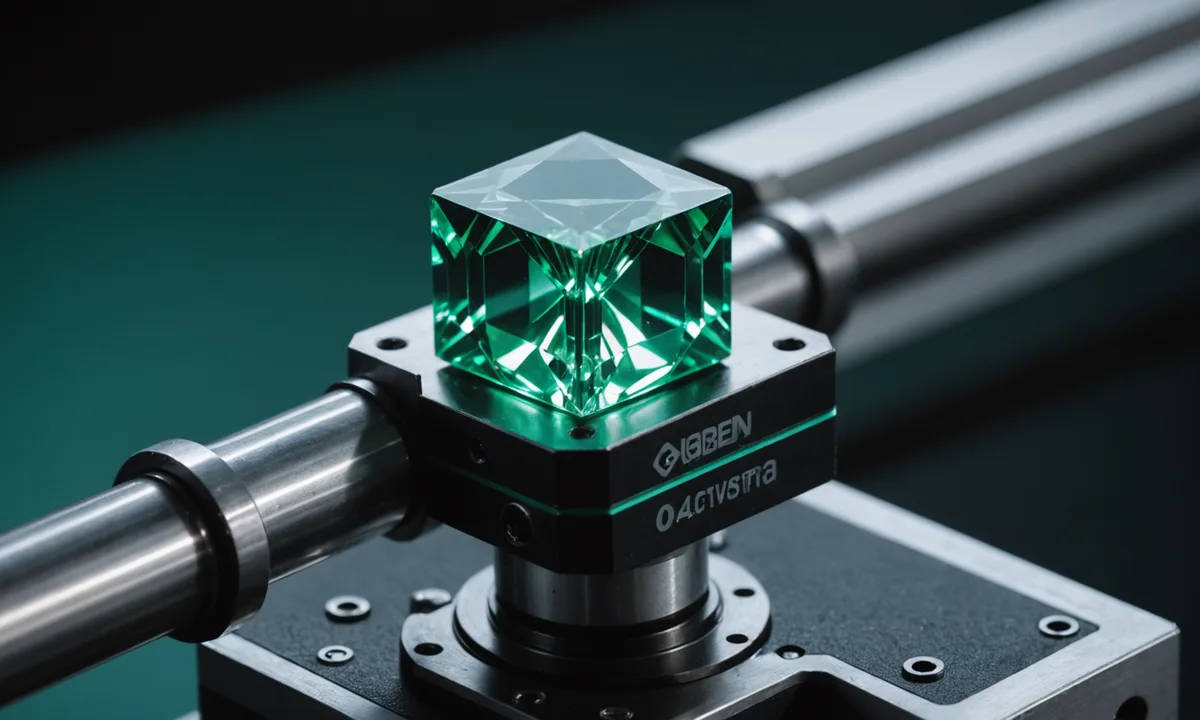
Diamond chip construction
Each sensor is built on a single-crystal diamond substrate grown by chemical vapour deposition, with NV centers created by nitrogen ion implantation at controlled dose and depth.
CVD diamond substrate
The diamond host is grown by microwave plasma CVD at high purity (nitrogen concentration below 5 ppb before implantation). Substrate orientation is selected to maximise the density of aligned NV centers in the final implanted device.
- Type IIa CVD diamond, [100] orientation
- Optical-grade polish for 532/637 nm transmission
- Nitrogen implantation depth profile: 50-200 nm
- Post-implant annealing at 900 C for vacancy migration
From photon to field vector
Raw fluorescence to calibrated field measurement in four processing stages, executed in firmware and software on the sensor module.
Single-photon avalanche diodes collect 637 nm fluorescence during the optical readout window. Integration time is adjusted for the target bandwidth.
Microwave frequency is swept across the spin-resonance window. The dip pattern in fluorescence intensity encodes the local magnetic field via the Zeeman effect.
Our neural signal model separates overlapping resonance lines from NV centers at different orientations, extracting the full field vector from the ensemble spectrum.
Temperature-corrected calibration coefficients are applied in-situ. A built-in reference line ensures absolute accuracy across field deployment temperature swings.
Current generation sensor specifications
Parameters for the DeteQt Gen-2 sensor module. Values are measured at 300 K unless stated.
| Parameter | Value | Conditions |
|---|---|---|
| Magnetic noise floor | <10 pT/Hz | 1 Hz - 1 kHz, 300 K |
| Measurement bandwidth | DC - 1 kHz | Standard mode |
| Dynamic range | 1 nT - 1 mT | Auto-gain |
| Operating temperature | -20 C to +60 C | Sensor module |
| Chip footprint | 3 x 3 mm | Diamond substrate |
| Module volume | 45 x 35 x 20 mm | Including optics + MW drive |
| Power consumption | 2.8 W (typical) | Full operation |
| Interface | USB-C / SPI | Digital output |
| Field axes | 3-axis vector | Full field vector |
| Absolute accuracy | <1% full-scale | Post-calibration |